Tongue River – The State of the Watershed Discussion – Meeting February 26th, 9am-12pm in Miles City
Tongue River - The State of the Watershed Discussion Purpose - share information to create an…

Yellowstone River Conservation District Council
Regenerative Agriculture in Action: Dan and Tami Sanders’ Journey on the Yellowstone
Nestled at the foot of the Crazy Mountains in Big Timber, Montana, Dan and Tami Sanders have embarked on a mission to transform their leased 500-acre ranch into their own unique model of regenerative agriculture. Guided by the wisdom of established area ranchers and fortified with modern regenerative practices, the couple endeavors to balance traditional knowledge and innovation to address contemporary agricultural challenges.
A Unique Partnership
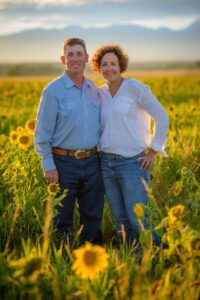
Dan, a veteran Air Force pilot with an engineering degree, and Tami, a microbiologist and certified Soil Food Web Consultant, bring a powerful combination of skills to their operation. Both are honing their approach through Holistic Management International courses, learning to balance ecological health with economic sustainability. Their dedication to their craft stems from a shared commitment to local food systems and a strong connection to their community.
The Challenge: Too Much Water and Heavy Clay Soils
The Sanders’ ranch benefits from operating in the Yellowstone valley; working on irrigated acres and receiving most of their water from a canal system fed by a tributary to the river. Yet, this proximity and low-lying ground also presents a significant challenge: too much water and too much clay. High water tables and aging, leaky irrigation ditches have caused persistent saturation in parts of their fields, impacting soil health and crop productivity.
“Water is both a blessing and a challenge,” Dan notes. Managing areas that drain poorly and collect water has been an ongoing struggle.”
A Helping Hand: Yellowstone River Conservation District Council and NRCS
Recognizing the complexity of their water management issues, the Sanders turned to the Yellowstone River Conservation District Council (YRCDC) and the Natural Resources Conservation Service (NRCS) for support. Through a partnership with NRCS, the YRCDC provided technical assistance in Irrigation Water Management (IWM), a critical tool for optimizing water use and minimizing its adverse effects and the Boulder River Watershed Association helped with funding and support for irrigation infrastructure, enabling this essential work.
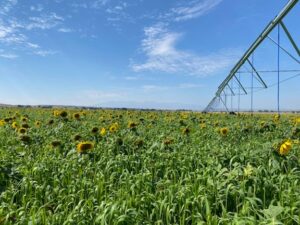
With Cameron Skinner, YRCDC’s technical specialist specializing in Irrigation Water Management, and Cooper Schicke, a Soil Conservationist from the USDA’s NRCS, the Sanders met under their 134-acre pivot to discuss problems and explore potential solutions.
IWM involves a suite of practices designed to improve the efficiency of irrigation systems while reducing runoff and waterlogging. For the Sanders, this included a comprehensive assessment of their irrigation infrastructure and the development of tailored solutions to address their water challenges.
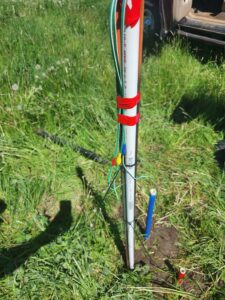
At the Sanders Ranch, part of the IWM involved 3 moisture sensor sites, all in distinct soil types, under their 134-acre pivot. With help from NRCS and YRCDC, who assisted in installing the sensors and interpreting the data, the Sanders are better able to see how their heavy clay soils behave, water infiltration rates, the height of the water table, and other variables to improve their irrigation efficiency, enhance crop production, ecosystem services, and profitability.
“The resources the NRCS and YRCDC provide have allowed us to better understand in real time how irrigation and precipitation are handled by our soils,” said Tami.
Implementing the Five Principles of Regenerative Agriculture
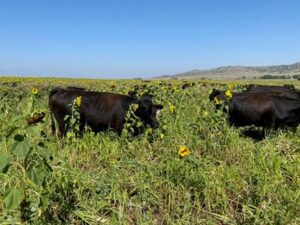
With the support of YRCDC and NRCS, the Sanders are working on applying the five principles of regenerative agriculture to their ranch:
These practices, combined with improved water management, should lead to improved soil health, but it’s a slow transition. The end goal is reducing waterlogged areas, improving water infiltration and growing vibrant crops.
A Community-Centered Approach
For Dan and Tami, regenerative agriculture extends beyond the boundaries of their ranch. They actively engage with their community, sharing their experiences and learning from neighbors, including experienced area ranchers whose practical wisdom complements their scientific and technical expertise.
“Regeneration is about more than soil,” Dan emphasizes. “It’s about regenerating community ties, furthering the local economy, and honoring the knowledge that has been passed down for generations.”
Looking Ahead
Dan and Tami Sanders embody the resilience and resourcefulness that define Montana’s agricultural heritage. Their story highlights the transformative power of collaboration, where partnerships with organizations like YRCDC, NRCS, Boulder River Watershed Association, and the USDA, act as catalysts for sustainable farming.
As they continue their journey, the Sanders remain committed to their vision of a healthier, more connected agricultural landscape—a vision that inspires not only their community but also the broader region to embrace the principles of regeneration and stewardship.
“We’re just getting started,” Tami says with a smile. “The land has so much to teach us, and we’re eager to keep learning.”